
Theses
Dear Students,
We would like to provide you with an overview of possible topics for your thesis. This is intended solely as a starting point.
You are welcome to propose your own topics at any time, provided they are related to quantitative business administration or logistics.
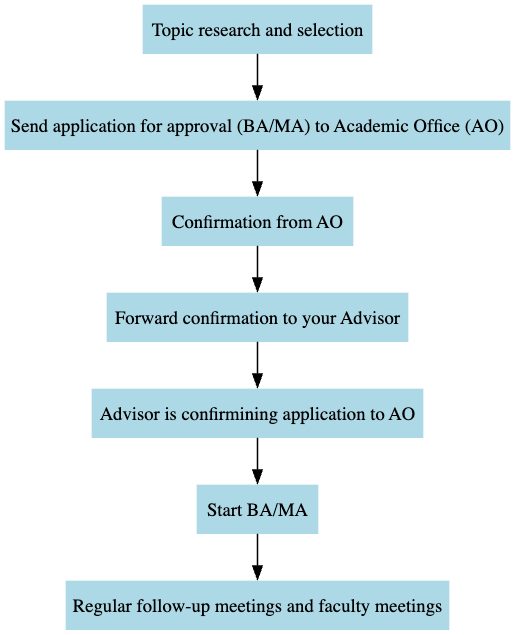
The specific topic will be developed during an initial preliminary meeting with your advisor. Please also refer to the typical process for registering your thesis (figure).
If you have any questions, please contact us at the following address: nlms.bwl@uni-hamburg.de
Topic Framework
*BA=Bachelor, MA=Master
Empirical Study of Commuting Patterns and Bicycle Use at the University of Hamburg (BA) Sustainable Campus Mobility Over Time: A Longitudinal Analysis of Commuting Patterns at the University of Hamburg (MA)
As part of a university-wide survey conducted in cooperation with the Sustainability Office, the current commuting patterns of all members of the University of Hamburg are being recorded in detail and analyzed, with a particular focus on bicycle use.
The Influence of Behavioral Variables in the Mathematical Optimization of Boarding Processes
Mathematical models for calculating the optimal boarding sequence make an important contribution to improving efficiency in air travel; however, human behavior is difficult to predict. This thesis analyzes the key behavioral variables that significantly influence actual boarding times. It examines which mathematical methods and approaches can be used to model factors such as passenger grouping, baggage stowage, or individual passenger delays.
Furthermore, the thesis addresses the question of which additional parameters or methodological extensions could be used to model human behavior more realistically. The thesis thus offers both a well-founded overview of the current state of research and valuable insights for the further development of theoretical optimization strategies.
Category-Based Learning Curves in Single-Machine Scheduling: Solution Methods and Implications for Production Ordering (BA)
In the production of different product categories, employees learn through repetition within a category but partially lose this advantage when switching to another category. This thesis focuses on a scheduling model that models and implements this effect using discrete product groups. In addition, various heuristic solution methods for different objective functions will be compared and analyzed.
Empirical Study/Market Analysis on the Barriers and Success Factors of PERT Application in Project Management (BA/MA)
This thesis uses qualitative expert interviews to examine the extent to which the Program Evaluation and Review Technique (PERT) is used in project planning in today’s business practice. The goal is to identify the specific barriers to its application and to identify the factors that determine the success or failure of this planning method in real-world management.
Optimal Sequencing Accounting for Learning and Forgetting Effects: Model Analysis and Dynamic Programming Algorithm (BA)
In production, employees become faster through repetition of similar tasks. However, when they switch to a different type of task, some of this learning progress is lost. This thesis examines how such learning and forgetting effects can be mathematically modeled and which sequence minimizes the total runtime. The focus is on how the similarity between different task types influences forgetting rates and, ultimately, the performance of the scheduling.
The Rebalancing Problem in the Context of Bike-Sharing Systems: A Theoretical Analysis of Optimization Models and Their Application to an Urban Bike-Sharing System (BA/MA)
This thesis examines the rebalancing problem in the context of bike-sharing systems, with the goal of cost-minimizing the redistribution of rental bikes among bike stations. Following a theoretical analysis of the fundamental mathematical formulations of the various optimization models and benchmark instances, static and dynamic variants, as well as their solution approaches, are classified. Optionally, the optimization model can also be applied using empirical data from bike-sharing operators (e.g., StadtRAD) to simulate, for example, the need for redistribution and potential efficiency gains.