University of Hamburg Business School
University of HamburgBusiness School
Photo: UHH/Denstorf
2 April 2026
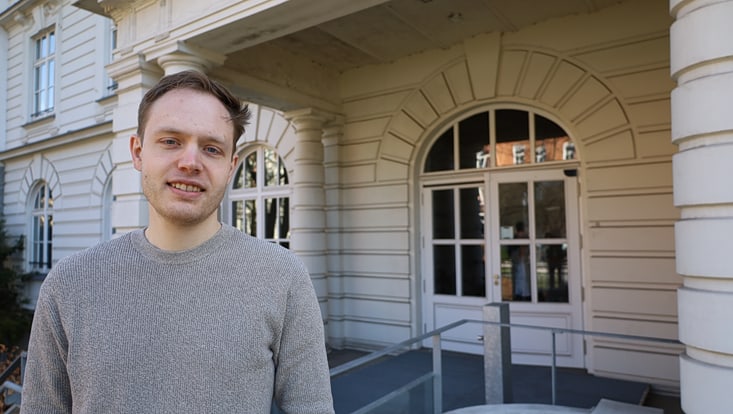
Photo: UHH/Longe
Dr. Sven Klaaßen, a research assistant in the Department of Statistics, has accepted an appointment as a junior professor on a tenure-track position at the University of Kiel. To mark the occasion, we spoke to him about his experiences in his studies and research.
Dr. Sven Klaaßen, research assistant at the Professorship of Statistics under Prof. Dr. Martin Spindler, has accepted a position as a junior professor on a tenure track at Kiel University. From 1 May, he will be teaching statistics and empirical economic research there. As he leaves, we asked him about his experiences at the School.
I started at the Business School as a research assistant in January 2017. Before that, I studied Mathematical Economics at the University of Hamburg.
I was driven above all by a fascination with machine learning and the enormous potential of modern algorithms in the analysis of complex datasets. The PhD offered me the academic freedom to delve deeply into these methodological questions and develop innovative solutions to real-world statistical problems.
My focus is on combining machine learning with causal inference. Whilst traditional algorithms primarily operate as ‘black boxes’ to make precise predictions based on data patterns, the integration of causal inference makes these complex models interpretable. The aim is to uncover genuine cause-and-effect relationships. This is particularly valuable in active decision-making processes where different courses of action need to be compared and their impacts assessed. What is particularly exciting is the journey from theory to application: implementing these methods in practice is a highly motivating process. My colleagues and I are working on making the theoretical findings usable in practice through freely available software. A key result of this work is the open-source software package DoubleML, which allows the methods to be applied directly.
Above all, the close and trusting collaboration with my colleagues at the Institute of Mathematics and Statistics. The joint research projects and the time spent teaching were a formative experience for me.
I identify strongly with ‘Impact’. In my research, it is important to me to generate real added value for society and the economy through innovative, methodologically sound insights.
The classic answer: meeting my new colleagues and the chance to bring fresh ideas to my research and teaching.
We wish you all the best in your new role at the University of Kiel and look forward to staying in touch with you as an alumnus.
This content has been translated automatically.