
University of Hamburg Business School
University of HamburgBusiness School
Photo: UHH/Denstorf
10 January 2026
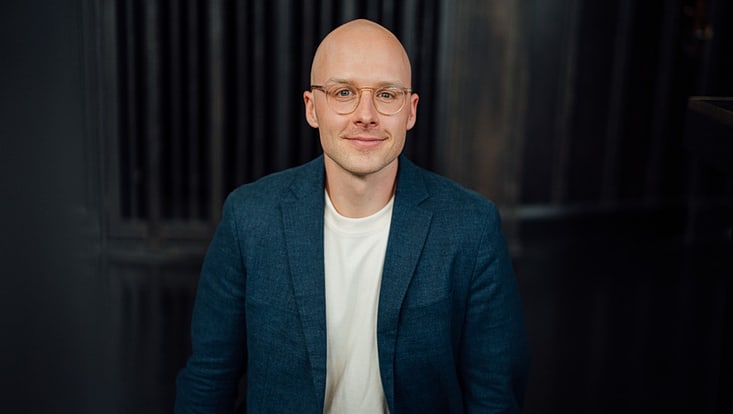
Photo: Mirjam Kilter
The logistics expert offers insights into balancing an academic career, entrepreneurship, and family life.
Dr. Tobias Vlćek, 31, is a research assistant and postdoctoral fellow at the Institute for Logistics, Transportation, and Production under Prof. Dr. Knut Haase. In addition to his academic career, he is involved with various companies, thereby combining theory with practical experience. He is also the father of two children, ages 4 and 6.
In an interview, he explains what motivates him on his path and how he manages to meet all the challenges.
Dr. Tobias Vlćek: BeyondSimulations is a consulting firm through which I primarily implement practical projects in the field of mathematical optimization and simulation using software programming. My goal is to apply the theoretical knowledge that already exists at universities to real-world applications. At the same time, I also offer workshops in these areas and on working with generative artificial intelligence (gAI), which I also use extensively in my work.
decorum SOLAR is a modern small business. We install balcony power plants for corporate and private customers in the greater Hamburg area, including on facades, tiled roofs, and flat roofs. Unlike many long-established craft businesses, we are highly digital: customers can calculate the price for installation and potential electricity savings directly on our website with no obligation. Images can be uploaded directly, and we can usually provide fixed-price quotes within a day with minimal effort on our part. We also set ourselves apart from other providers by ensuring that we use only high-quality components, particularly for the substructures.
I founded BeyondSimulations on my own in early 2023, after submitting my dissertation. As part of my doctoral studies, I had already collaborated with several industry partners, and I really enjoyed the work. After completing my doctorate, I wanted to continue and expand on this work, as I wasn’t yet sure where my path would lead me.
I co-founded the company decorum SOLAR in the summer of 2023. I had installed a balcony solar power system at my place in early 2023. My parents saw it and were also interested, but they found it too difficult to install the whole thing themselves and choose the right parts. So I helped them. This led to my grandparents also becoming interested in a balcony power plant. However, in their case, installation was only possible on a tiled roof. I didn’t know much about that, so I first looked to see if there were any professional providers in Hamburg. And: There weren’t any. In the spring of 2023, I was on vacation with my uncle Peter Goehle, who owns his own contracting business, among others, and we talked about it. On the very first day, we decided to just give it a try together with a new company in this field. Not even three months later, we founded decorum SOLAR and have since installed well over 100 systems in Hamburg and the surrounding area.
At BeyondSimulations, I handle all tasks. I’ve become very skilled at programming and working with gKI, and I can also implement larger projects very efficiently. However, I can always count on support from Planningio GmbH and desior GmbH, both of which were also founded at the University of Hamburg. I’m very good friends with their staff, and we often collaborate when needed. Furthermore, with Prof. Dr. Knut Haase, I always have someone who is there to support me.
At decorum SOLAR, I’m really just in an advisory role now, helping with the selection of suitable components and the strategic direction. The day-to-day operations are managed by Leon Goehle, who works full-time at the company and also holds shares.
Essentially, I bear the financial risk for both startups. I own 100% of BeyondSimulations GmbH, which in turn holds a 33% stake in decorum SOLAR GmbH. However, I have financial security through my job at the University of Hamburg, which has allowed me to launch both companies as a side business. Furthermore, my partner is also successful in her career, so we do not feel we are taking on any significant risk.
At the university, I learned much of what I am now able to apply in the real world. I also established many professional contacts and built my network through the university. However, Prof. Dr. Knut Haase has also played a major role; he has inspired both me and others, and as an unofficial mentor, he has guided us in taking our first steps toward self-employment. I am very grateful to him for that! Furthermore, practical projects often end up becoming academic papers, such as my current research topic on metro access control, which was inspired by a real-world problem.
I would recommend taking advantage of the entrepreneurship programs and startup workshops offered by the University of Hamburg Business School. I myself attended two excellent workshops led by Prof. Dr. Michel Clement on the topic of entrepreneurship—once as a master’s student and again as a doctoral candidate. It was very helpful to simply explore the topic of “entrepreneurship” freely and without pressure as part of a course module. The mentoring program is also a great opportunity, and I’m lucky to have found a fantastic mentor in Markus Hamer, in addition to Prof. Dr. Knut Haase.
Furthermore, having a basic income is also helpful and helps mitigate the risks of starting a business. Many positions at the university are now (unfortunately) only 75% positions.
But that also gives you the chance to make the most of it and put the remaining 25%, as well as an additional 8–9 hours per week (since 48 hours per week is the maximum allowed working time), into your own startup ideas.
I don't really have a set formula, but I'm a big fan of Emily Oster's books. Her books take a humorous look at managing a family like a small business. My partner and I have a shared calendar where we enter all our appointments, the kids’ schedules, and other plans. This way, we’ve divided childcare fairly and always know how much time we have available in the coming days. This allows us to plan our tasks well. When we do have time with the kids, we really enjoy it. We play with them, take trips to the museum, the playground, or just downtown. The only thing that might get a bit neglected is that we both rarely do things with the kids at the same time. Beyond that, I’m also a heavy user of generative AI (gAI), as it helps me work faster—and in some cases better—especially when programming smaller projects. Also, I don’t see my “work” as a chore that I don’t enjoy. I find it exciting to pursue different topics at the same time, and I really enjoy the variety. That’s why I’m not exhausted by work—I actually always have enough energy to spend quality time with my kids.
I’ve been asking myself that for a long time. Now I’ve reached the point where I’d like to combine the two. But not just in the sense of combining practice and research. For me, teaching is just as much a part of university as research, and I truly enjoy it. It’s precisely the variety of research, teaching, and practice that ensures that, despite the time demands, it doesn’t feel like work to me. I’d like to hold onto that feeling.
This content has been translated automatically.

