
University of Hamburg Business School
University of HamburgBusiness School
Photo: UHH/Denstorf
23 January 2026, by Denise Longe
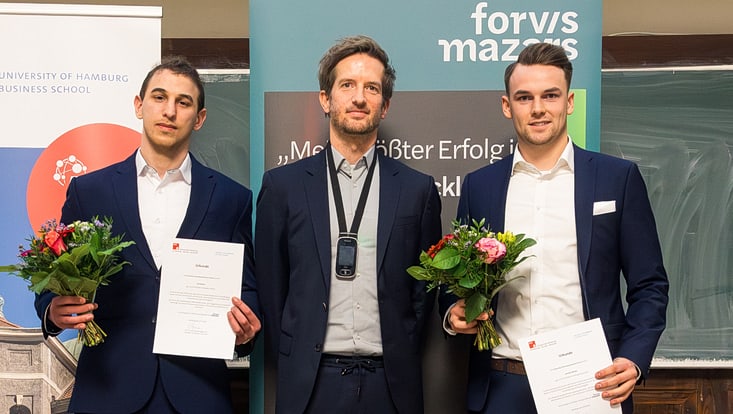
Photo: Rahel E. Photography
Two graduates of the Master’s programme in Business Administration are the recipients of the ERS Award for the 2025/26 winter semester.
At the graduation ceremony of the School, Kai Wuttke, Partner for ESG & Sustainability at the audit and consulting firm Forvis Mazars in Germany, presented this year’s ERS awards. Jannik Fahren and Ali Dohier, graduates of the Master’s programme in Business Administration, were recognised for their theses in the field of Ethics, Responsibility, and Sustainability (ERS).
“In times of crisis, sustainability is more important than ever, in every area,” says Kai Wuttke. “I am therefore all the more delighted to be able to use the ERS Prize to bring this issue even more into the spotlight and to recognise young people for their commitment to it.”
The prize, funded by the audit and consultancy firm Forvis Mazars, is worth 500 euros per winner and is awarded twice a year to the two best Bachelor’s and Master’s theses of the semester.
In an interview, the two prize winners spoke about the topics of their work, the support they received from the Business School, their motivation, and whether their work had influenced their career choices.
My topic is: ‘The impact of microloans on (social) entrepreneurship in developing countries’
I wrote this thesis at the Chair of Marketing & Media in collaboration with Professor Dr Michel Clement. I would like to take this opportunity to express my sincere gratitude for his dedicated and expert supervision of my Master’s thesis. Through his professional expertise, his constructive suggestions and his consistently helpful and patient support, he has made a significant contribution to this work. I would particularly like to thank him for our regular discussions throughout the entire process, as these enabled me to gain a fresh perspective on the subject matter.
Two aspects of this topic struck me as particularly interesting: firstly, I had a personal interest in economic interrelationships and the question of the extent to which financial instruments can generally contribute to wealth creation and prosperity. Secondly, the issue of global social inequality played a central role. Of particular interest was the question of whether microcredit, as a financial instrument, can make a sustainable contribution to economic self-reliance and poverty reduction, particularly among disadvantaged population groups. The aim of this thesis was therefore to critically analyse the potential and limitations of microcredit and to examine its actual contribution to socio-economic development in developing countries.
No, my dissertation did not have a direct impact on my career. I chose to pursue a career in Audit & Advisory and now work for a medium-sized consultancy firm. Nevertheless, the work had a lasting impact on me, particularly in terms of working independently, structured organisation, thorough research, and clear, targeted communication. The skills I acquired during that time are also of great benefit in my day-to-day work today.
The topic of my Master’s thesis was: “ESG Engagement as a Competitive Advantage: An Analysis of Relevant Measurement Criteria and Their Significance for Customers”.
In this thesis, I examined the extent to which ESG-related engagement (ESG stands for Environmental, Social, Governance) by companies can act as a factor that sets them apart from the competition, and which sustainability criteria are of particular relevance from the customer’s perspective. The analysis drew on the academic concepts of the market-based and resource-based views to theoretically derive potential competitive advantages.
Furthermore, the current state of research on ESG measurement criteria was analysed, existing research gaps were identified, and, building on this, a proprietary definition of the environmental dimension was developed. Finally, this theoretical perspective was compared with the economic reality of the aviation industry. In doing so, I had the privilege of interviewing airlines around the world and, from a strategic perspective, deriving recommendations for action for the thesis’s industry partner, Lufthansa Technik.
My Master’s thesis was supervised by Prof. Dr Kay Peters (SVI Endowed Chair in Dialogue Marketing). His often critical but always highly constructive feedback played a key role in helping me to continually refine the academic standards of the thesis, clearly identify its central research questions, and thereby significantly improve the overall quality of the work.
Sustainability and sustainable business practices are much-discussed topics that are becoming increasingly important both socially and commercially, and for me personally, they are among the most relevant issues for the future. As such, I didn’t have to think twice when the opportunity arose to explore the topic in greater depth within an industry as high-profile in the media as aviation.
Yes, I think you could say that. The close collaboration with Lufthansa Technik’s Aircraft Component Services division, as well as the trust and support I’ve been shown in my work, have definitely left a lasting impression and shaped my desire to continue working in this industry in the long term.
I am therefore all the more delighted that I recently received an offer to take up a full-time role there as a project manager.
This content has been translated automatically.

