University of Hamburg Business School
University of HamburgBusiness School
Photo: UHH/Denstorf
3 July 2026
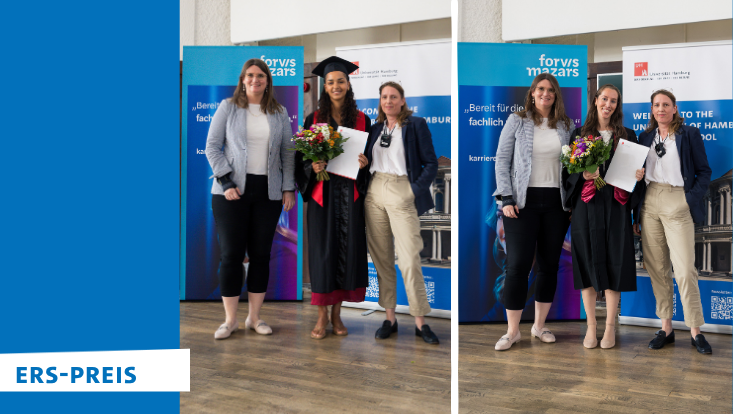
Photo: Rahel E. Photography
The two master’s graduates, Anouk Chimi Wadjou and Melina Savvidou, have received the Forvis Mazars ERS Award—sponsored by the auditing and consulting firm—for the best theses in the field of Ethics, Responsibility, and Sustainability (ERS).
At the graduation ceremony for the bachelor’s and master’s programs in business administration, tradition dictated that not only were the graduates honored, but awards were also presented for the best theses in the field of Ethics, Responsibility, and Sustainability (ERS). The ERS Prize is sponsored and presented each semester by the auditing and consulting firm Forvis Mazars. It is endowed with 500 euros per recipient.
This year’s winners, Anouk Chimi Wadjou and Melina Savvidou, accepted the award from Dr. Katrin Meyer, a partner at Forvis Mazars, for their outstanding master’s theses. The alumna of the Faculty of Economics and Social Sciences has strong ties to both the University of Hamburg and the field of sustainability. “I have a very personal history with the University of Hamburg—as a graduate, doctoral candidate, and former research assistant, where I helped develop the first courses in sustainability together with Prof. Bassen,” says Katrin Meyer. “The topic of sustainability has been with me for over 20 years—and especially in the current climate, we see that the challenges are not getting any smaller. That’s why it’s so important for students to boldly work on new, practical approaches in the fields of business and management—and that’s exactly what the ERS Prize recognizes.”
Read more about the award winners and the topics of their theses in the interview.
MSc in Business Administration
Thesis Topic: The Impact of Microcredit Design on Economic Development and Women’s Empowerment: A Literature Review
Advisor: Prof. Michel Clement, Professorship for Marketing and Media
For my master’s thesis, I wanted to take the opportunity to delve deeply into a new and socially relevant topic.
During an internship at an organization that provides microloans to women, I had my first exposure to the topic of microfinance.
I was particularly interested in the question of what impact microloans—which are predominantly granted to women—have on economic development and women’s empowerment, and whether they can contribute to improving living conditions in the long term.
Since I hadn’t yet dealt with microloans during my studies, my master’s thesis was the ideal opportunity to do so.
The most important lesson I learned from my master’s thesis was how crucial a systematic approach is for a large-scale research project. The structured approach to the literature review played a key role in successfully navigating the complexity of the topic. The skills I developed in the process continue to support me in my daily professional life.
In terms of content, I was particularly surprised to find that, despite their widespread popularity, microcredit programs are generally not as effective in practice for poverty reduction and women’s empowerment as originally hoped. My analysis showed that their impact depends heavily on their specific design and on complementary measures.
I would like to take this opportunity to express my sincere gratitude to Prof. Michel Clement for his excellent guidance, valuable suggestions, and regular dialogue throughout the entire research process. His support was instrumental in the success of my master’s thesis.
My master’s thesis did not fundamentally change my career aspirations, as I had already gained some initial professional experience in marketing and product management before writing it. Today, I also work in marketing (product management and communications). However, the thesis further strengthened my interest in topics with social relevance, so I would be very happy to get involved in projects with a positive social impact in the long term.
MSc in Business Administration
Thesis Topic: Psychological Safety at Work—A Critical Review of the Current State of Research
Advisor: Prof. Dorothea Alewell, Professorship of Human Resource Management
I first read about the concept of psychological safety (PS) in the Harvard Business Review. When I heard that Prof. Alewell was offering a seminar on this topic, I signed up immediately. This allowed me to explore the topic academically for the first time:
First, through a seminar paper in which I examined the influence of two different leadership styles (transformational and inclusive leadership) on PS in the workplace. Second, through the presentation of a paper by Arnetz et al. titled: “Organizational determinants of bullying and work disengagement among hospital nurses”[1]. The focus here was on the healthcare sector. The researchers demonstrate that PS has a significant positive influence on the reporting of bullying experiences in the workplace and can also counteract absenteeism. During my research, I noticed gaps in the literature. In German-speaking countries in particular, relatively little research has been conducted on PS to date.
The following semester, I learned that Prof. Alewell was offering the topic of PS among the topics she had listed for master’s theses in human resource management. Since I am very interested in health economics (we are all aware of the challenges currently facing the healthcare industry), I am very grateful that Prof. Dr. Alewell accommodated my preference to focus my thesis research on the determinants that are becoming increasingly relevant in the healthcare industry.
The concept of PS is often misunderstood. PS is not the same as having a nice boss who lets everything slide. Nor is it a description of an atmosphere in which every mistake is accepted without reflection. Rather, all team members should be able to express their opinions and ideas and acknowledge their own mistakes without fear of personal repercussions. Taking interpersonal risks can be fraught with shame and discomfort. However, current research makes it clear that PS has a significantly positive influence on learning processes, that PS can contribute to increased productivity, and that it can foster innovation. In the healthcare industry, PS can counteract performance-inhibiting power distance or the prevalent practice of knowledge hiding, which poses high risks, particularly in hospitals.
Furthermore, it became clear to me that, under certain conditions, PS can be an effectiveness-enhancing concept and, particularly in the healthcare sector, creates monetary incentives for corporations, though it also has its limitations. In conclusion: Leaders play a central role—one that should by no means be underestimated—in the implementation and maintenance of PS.
For my professional future, I would like to work in an organization that gives me the opportunity to learn continuously. Learning is a central aspect of psychological safety and the foundation for high performance and innovation.
If I were to have the opportunity to become a leader myself in the future and my employer is open to the concept, I would like to advocate for the implementation of psychological safety in teams. It remains to be seen what key areas will emerge in the future regarding psychological safety, particularly in light of the growing influence of artificial intelligence.
In closing, I would like to express my sincere thanks to the selection committee and to Dr. Meyer of Forvis Mazars for awarding me the ERS Prize. I would also like to extend my heartfelt thanks to my advisor, Prof. Alewell. She was always there for me and, through her specific questions about my approach to the thesis, encouraged me to reflect and think more deeply.